Yin Earth Day Master (Gi 己): Saju Personality, Career & Love
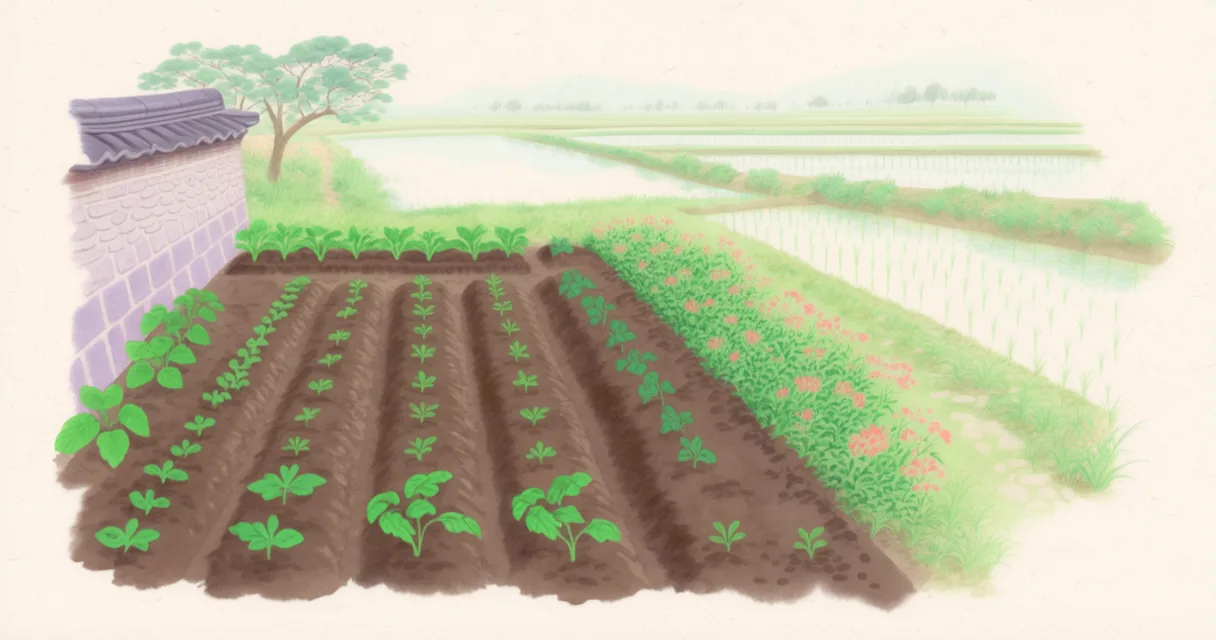
Short answerGi Earth (己土) is Yin Earth, likened to a vegetable patch that finely tends a small space; as a Day Master it is defined by fine adjustment and care.
| Element / Yin-Yang | Earth (土) / Yin (陰) |
|---|---|
| Symbol | The soil of a vegetable patch, fields and paddies, a flower bed, wetlands |
| Core keywords | Fine detail, complementing, gentle pace, upkeep |
| Strong fields | Management, caregiving, hands-on practical roles |
| Helpful elements | Byeong and Jeong Fire (Fire generates Earth), Gyeong and Sin Metal (Earth generates Metal) |
In this article 8
- What is Gi Earth?
- The symbol and nature of Gi Earth
- Gi Earth's hidden stems and the cycle of birth, peak and storage
- What is a Gi Earth Day Master's personality?
- Gi Earth's shadow: timidity, idle worries, self-deprecation
- How is Gi Earth read in each position of a saju?
- Gi Earth as the Year Stem
- Gi Earth as the Month Stem
- Gi Earth as the Day Stem
- Gi Earth as the Hour Stem
- Gi Earth Day Master men and women
- A Gi Earth Day Master in love and relationships
- What careers suit a Gi Earth Day Master?
- What energies are good for Gi Earth?
What is Gi Earth?
Gi Earth (己土), the Yin Earth stem, is the sixth of the ten Heavenly Stems and the Earth of Yin. I portray Gi Earth as soil spread over small spaces such as wetlands, hills, flower beds, farmland and vegetable patches. Even within the same Earth, if Mu Earth is the land of wide plains and plateaus, Gi Earth is the soil of a vegetable patch or rice paddy within arm's reach. Unlike Mu Earth, which takes things in on a large scale and mediates, Gi Earth is a main character that gathers resources in small units, divides them finely and keeps them going.
In my book From Today, I've Decided to Be the Main Character, part of my Korean book series in which I reread Myeongri as the story of one's own life, Gi Earth is the soil of the change of seasons that finely coordinates between seasons. It is a slow catalyst that mediates environmental factors so that things are neither too dry nor too damp. I do not see Gi Earth as the commonly described "weak soil." Rather, it is closer to an invisible hand that gently pushes over a long time so that the whole system can adapt without strain.
The symbol and nature of Gi Earth
| Aspect | Description |
|---|---|
| Nature image | Vegetable patches, fields and paddies, flower beds, wetlands, small flat ground at the foot of a mountain |
| Core attributes | Stability, embracing, fine adjustment, the power to buffer, gentle pace |
| Seasonal energy | Between seasons: a turning period of frequent weather changes |
| Way of working | Filling the gaps and maintaining and complementing a fine balance |
| Thinking structure | Awareness of details, multilayered and long-term strategies of spreading risk |
Gi Earth gathers resources in small spaces rather than large ones, divides them and keeps them going. Its main role is pacing, upkeep and everyday repair rather than large-scale change. The core of Gi Earth is leading a gradual transition without sudden breaks. When spring passes and summer ripens into the fruition of autumn, it is Gi Earth that adjusts the humidity at the seams and fills the imbalances. In nature, it is the soft soil of fields and paddies, a damp hill where dew and fog come again and again, the foot of a mountain where weeds and moss quietly spread. It is soil that, though not showy, becomes the basic habitat of countless living things. This grain is the Yin (陰) side of Earth spread out as it is.
Gi Earth's hidden stems and the cycle of birth, peak and storage
When the Heavenly Stem Gi Earth meets the Earthly Branches, it pairs with the Earth branches. When I gauge the roots of a Gi Earth Day Master in a saju, I look first at Mi (未) Earth and Chuk (丑) Earth. Mi Earth holds Jeong Fire, Eul Wood and Gi Earth and is the warm, dry soil of summer; Chuk Earth holds Gye Water, Sin Metal and Gi Earth and is the cold, damp soil of winter. Even the same Gi Earth, rooted in Mi Earth, is dry and needs the binding of Gap Wood and moisture; rooted in Chuk Earth, it has too much dampness and badly needs the sunshine of Byeong Fire. In this way, which branch it takes root in makes the grain of the same Gi Earth Day Master different.
What is a Gi Earth Day Master's personality?
Strengths
- Practical skill that recognizes details and manages them stably
- Fine adjustment that fills the gaps and complements the balance
- Prudence that spreads risk with various safeguards
- Tenacity that tends and maintains an environment steadily for a long time
- Sincere care of nurturing and embracing that looks after even small lives
Weaknesses
- They may hesitate when a sudden decision is needed
- A tendency to miss the big flow while immersed in details
- Accepting change slowly, so pushing forward is slow
- They do not readily show what is inside, so they can seem frustrating
Gi Earth's shadow: timidity, idle worries, self-deprecation
In consultations I often see the shadow of a Gi Earth Day Master. The soil of a vegetable patch reacts sensitively to even small changes. So Gi Earth tends to hold even trivial things in its head, turning them over as idle worries, and then put off the actual decision. The prudence of setting up many safeguards to spread risk becomes, when it goes too far, a timidity that cannot even start. Above all, when the habit of keeping inner feelings only inside deepens, the attentiveness that used to look after others turns toward itself as self-deprecation. When the muttering of "it's because I'm not good enough" grows, Gi Earth loses its light. What it needs then is sunshine. This is why the warm recognition of Byeong Fire and the reliable support of Gap Wood become medicine for Gi Earth.
How is Gi Earth read in each position of a saju?
Gi Earth as the Year Stem
It is the energy of stability and care that flows through the family. From childhood, an environment of looking after those around them attentively and tending things calmly easily becomes second nature.
Gi Earth as the Month Stem
The person inherits an eye for fine management in the social environment. It is a position that stands out when taking on roles that look after the details at work, such as hands-on practical work and operations.
Gi Earth as the Day Stem
This is the main subject of this guide, the "Gi Earth Day Master." The slow-catalyst way of filling the gaps, complementing finely and coordinating gradually becomes a lifelong pattern of action. Since the Day Master is the position that means yourself in a saju, the grain of Gi Earth becomes that person's basic way of operating.
Gi Earth as the Hour Stem
Gi Earth in the position of later life and children is the energy of stability deepening. As they grow older their attentiveness comes through, and their children often show a diligent, thrifty temperament.
See your own saju chart in Deokeum Manseryeok
Enter your birth date and time to see your Four Pillars, Day Master and five elements. The app is available in Korean only.
Gi Earth Day Master men and women
A Gi Earth Day Master man is the hands-on type who quietly looks after things. Rather than stepping forward, he finds his strength in filling the gaps and keeping things going. A Gi Earth Day Master woman's strength is a thrifty, attentive sense of running a household, so she tends even small parts stably and reliably holds up those around her. But common to both men and women, if they keep their true feelings only inside, that care does not reach the other person. Practicing putting their sincere care into words brings relationships to life.
A Gi Earth Day Master in love and relationships
They love stably, not noisily but steadily looking after the other person. They convey their sincerity through everyday care rather than flashy expressions. But if they keep their inner feelings only inside, the other person finds it hard to read their heart, so showing them honestly is the key to keeping a relationship going. Weeds do not grow in the vegetable patch only when small hurt feelings are let out as they come, rather than piled up as idle worries.
What careers suit a Gi Earth Day Master?
- Hands-on management and operations: stable practical skill that looks after details
- Caregiving and welfare: gentle, sincere care that looks after others steadily
- Accounting and general affairs: coordination skill that fills the gaps and keeps the balance
- Agriculture and gardening: a temperament that thriftily tends a small space
- Quality and maintenance: tenacity that complements things gradually
Gi Earth's strengths come alive not in a position that overturns a big game all at once, but in a position that endlessly refines small differences to stabilize the whole. To see which character in the whole saju nurtures this strength, you need the viewpoint of Yongsin.
What energies are good for Gi Earth?
| Structure | Energy | Heo Yu's interpretation |
|---|---|---|
| Fire generates Earth | Byeong Fire, Jeong Fire | Spread heat is gathered in as Gi Earth's resources |
| Earth generates Metal | Gyeong Metal, Sin Metal | The outlet that sends tended resources out as fruition |
| Binding (Wood) | Gap Wood | Holds soft soil firmly in place and gives it shape |
| Yin-Yang pair | Mu Earth | Large buffering that adds a foundation to Gi Earth's fine adjustment |
The first thing I recommend for Gi Earth is Byeong Fire. This is because the sunshine coming in through Fire generates Earth warms the vegetable patch that easily turns cold and damp, and finally makes it soil that can raise all things. Next comes Gap Wood. Soft Gi Earth loses its shape when it turns mushy, but when Gap Wood holds the soil with its roots, the vegetable patch does not collapse and goes all the way to fruition. The resources it harvests are carried again through Earth generates Metal onto Gyeong Metal and Sin Metal and go out as fruition.
The Di Tian Sui's chapter on the Heavenly Stems regards Gi Earth as "low-lying, damp (卑濕) Yin Earth," a field that raises all things without showing itself. The passage in the same text that says it wishes "Fire to be warm even when it is little, and Water not to sink it even when it is much (火少火晦, 水多水蕩)" points out how important the balance of Byeong Fire's warmth and the right moisture is for Gi Earth. The climate-balance (Johu) theory of the Qiong Tong Bao Jian, too, stresses again and again the balance of sunshine (Byeong Fire) and water for Gi Earth. Instead of the popular view's verdict of "weak soil," I read Gi Earth as a slow catalyst that leads the gentle adaptation of the whole system. If you are curious about the large partner of the same Earth, see the other grain of Earth in the Mu Earth Day Master guide, and if you are curious about the map of all ten Heavenly Stems, continue in the 10 Day Masters overview.
References
Classics & books
- Original by Jing Tu, commentary by Ren Tiechiao, Di Tian Sui (滴天髓), On the Heavenly Stems, Tongshen chapter, Heavenly Stems: Gi Earth
- Compiled by Yu Chuntai, Qiong Tong Bao Jian (窮通寶鑑), climate balance (Johu), On Gi Earth
Frequently asked questions
QWhat is the difference between Gi Earth and Mu Earth?
If Mu Earth is the soil of a wide plain, Gi Earth is the soil of a small space like a vegetable patch or a rice paddy. Mu Earth takes things in on a large scale and mediates; Gi Earth adjusts finely in small units.
QIs a Gi Earth Day Master indecisive?
It is not indecisiveness but a structure that avoids sudden turns and coordinates gradually. It is the prudence of setting up many small safeguards to spread risk.
QWhat is a Gi Earth Day Master good at?
Looking after details and keeping things going steadily. Its strengths come alive in roles such as management, caregiving and hands-on practical work, where small differences are refined and things are complemented stably.
QWhat is the best energy for a Gi Earth Day Master?
The sunshine of Byeong Fire and the binding of Gap Wood. Byeong Fire warms cold, damp soil and makes a place to raise all things, and Gap Wood holds soft soil firmly in place.
QWhat are a Gi Earth Day Master's weak points?
Getting absorbed in details and missing the big flow, and being slow to decide because of idle worries and timidity. If they keep their inner feelings only inside, they easily slide into self-deprecation.
QHow do I know if I am a Gi Earth Day Master?
Enter your birth date and time in a manseryeok; if the Heavenly Stem of your birth day is Gi (己), you are a Gi Earth Day Master. You can check it right away in Deokeum Manseryeok.
See your own saju chart in Deokeum Manseryeok
Enter your birth date and time to see your Four Pillars, Day Master and five elements. The app is available in Korean only.