Five Elements in Saju: Wood, Fire, Earth, Metal & Water
Short answerThe five elements (五行) are the five energies of Wood, Fire, Earth, Metal and Water; Heo Yu sees them as a manual for reading the background and psychology of the main character's stage.
| Classification | Five energies: Wood (木), Fire (火), Earth (土), Metal (金), Water (水) |
|---|---|
| Origin | The wisdom of observing nature (Book of Documents, "Great Plan") |
| Two uses | Month Branch = environment (the stage), Day Master = psychology (qi, substance, form) |
| Two relationships | Generating (the flow of the scenario), controlling (healthy tension) |
| Heo Yu's interpretation | A manual for the stage, not a label of fate |
In this article 5
- What are the five elements?
- The five elements are a manual for the stage, not fate
- What Wood, Fire, Earth, Metal and Water mean
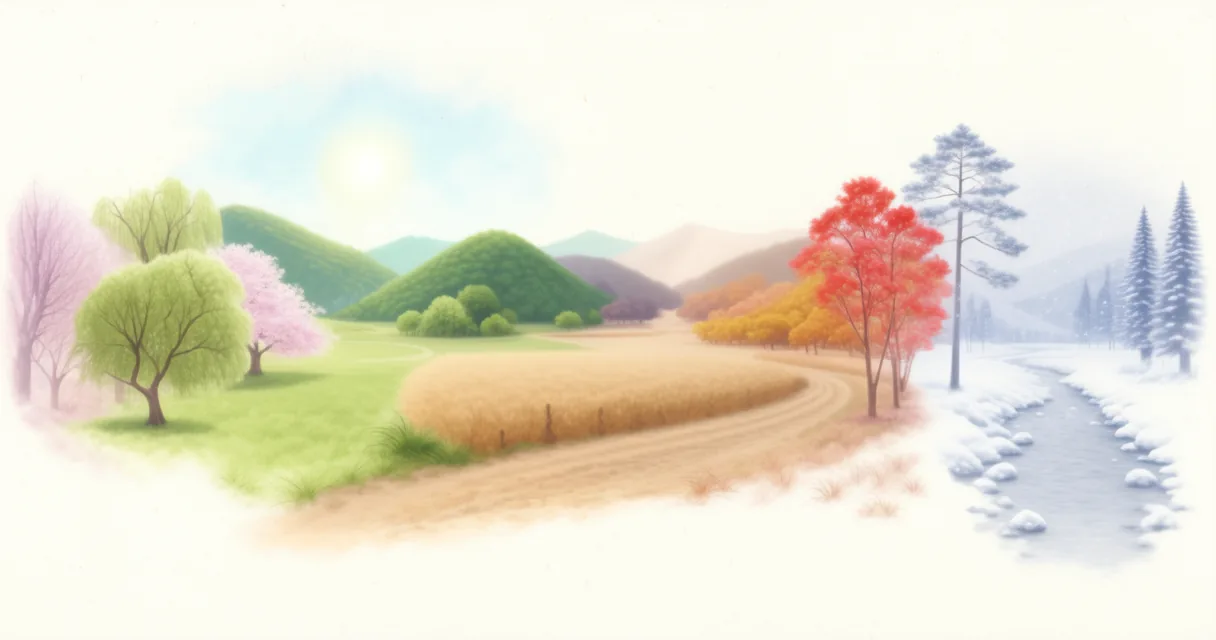
- The five elements are, in the end, another name for the four seasons
- The five elements are read in two ways: environment and psychology
- The five elements as environment: the stage called the Month Branch
- The five elements as psychology: the Day Master and qi, substance and form
- Not mixing the two axes is where interpretation begins
- The two relationships of the five elements: generating and controlling
- Generating: the flow of the story
- Controlling: the tension that turns crisis into opportunity
- How to check the five elements in your saju
What are the five elements?
The five elements (五行) are an East Asian classification system that reads change in the world through five energies: Wood (木), Fire (火), Earth (土), Metal (金) and Water (水). I do not read these five characters as "substances" such as wood, fire or soil. The five elements are five "actions," growth (Wood), spreading (Fire), mediation (Earth), gathering in (Metal) and condensing (Water), and five "seasons," spring, summer, the turn between seasons, autumn and winter. The roots of the five elements lie not in predicting fate but in wisdom gained from long observation of the seasons and nature. The "Great Plan" (洪範) chapter of the Book of Documents (書經) named water, fire, wood, metal and earth as five actions, saying, "Water soaks and flows downward, fire burns and rises upward, wood bends and straightens, metal yields and changes, and earth receives sowing and gives harvest." It is the oldest record to see the five elements not as things but as "directions of movement."
I do not use the five elements as a label that defines personality. The five elements are a precious manual that tells you the background and environment of the stage on which the main character, "me," will act. For a long time the world has used the five elements as a tool for flat verdicts such as "strong Wood energy means stubbornness," but I clear them of that false charge, return them to their original place, the wisdom of observing nature, and then use them again for "me." The same five characters say completely different things depending on where they sit. That is the starting point of how I read the five elements.
The five elements are a manual for the stage, not fate
Many people misunderstand Myeongri as determinism: "the eight characters you were born with decide your fate." But Myeongri raises neither hand in the old debate of nature versus nurture. It sees both the self you were born as (your genes) and the environment around you as decisive, and uses both together. That is why, when I read the five elements, I value distinguishing their use above all. Even the same "Wood (木)" is interpreted completely differently depending on whether it sits in a position that points to the environment or to your psychology.
What Wood, Fire, Earth, Metal and Water mean
Each of the five energies is one action of nature and one season. Read them not as substances but as "movements," and the original meaning of the five elements comes alive.
| Element | Action | Season | Name of the stage |
|---|---|---|---|
| Wood (木) | Growth that reaches straight upward | Spring | A stage for nurturing dreams amid support |
| Fire (火) | Spreading that surges upward | Summer | A stage for proving yourself amid competition |
| Earth (土) | Mediation that holds change | Turn between seasons | A stage for linking the world at the center of change |
| Metal (金) | Gathering in that hardens into form | Autumn | A stage for sorting gems from stones amid abundance |
| Water (水) | Condensing that soaks downward | Winter | A stage for preparing the next era in stillness |
The detailed stage and psychology of each element are covered in the Wood, Fire, Earth, Metal and Water guides.
The five elements are, in the end, another name for the four seasons
If I had to sum up the five elements as briefly as possible, I would say "the four seasons." Wood is spring, Fire is summer, Metal is autumn, Water is winter, and Earth is the turn between one season and the next. Every assignment in saju, from the Heavenly Stems and Earthly Branches to birth–peak–storage (生旺庫) and the generating and controlling cycles, ultimately flows from this single cycle of the seasons.
This "five elements = four seasons" correspondence is not a metaphor I made up; it is an established view rooted in classics two thousand years old. The "Tianwen" (天文訓) chapter of the Huainanzi wove the four directions, four seasons and five elements into one net: "The east is Wood and governs spring; the south is Fire (summer), the center is Earth, the west is Metal (autumn), and the north is Water (winter)." The same book also fixed the seasonal assignment of the Heavenly Stems and Earthly Branches: Gap-Eul and In-Myo are Wood, Byeong-Jeong and Sa-O are Fire, Mu-Gi is Earth, Gyeong-Sin and Sin-Yu are Metal, and Im-Gye and Hae-Ja are Water. The "Four Seasons" (四時) chapter of the Guanzi (管子) set the three months of spring as days of Gap-Eul, summer as Byeong-Jeong, autumn as Gyeong-Sin and winter as Im-Gye, and called "the four seasons the great road of Yin and Yang." The "Monthly Ordinances" (月令) chapter of the Book of Rites (禮記) stated the element that flourishes in each season, as in "the flourishing virtue is in Wood (盛德在木)" at each Start of Spring. In short, the four seasons (四時) of the classics and their assignment to Heavenly Stems and directions are the seasonal assignment of the five elements in saju, and my frame of reading the Month Branch as "the stage of the season on which the main character stands" rests on this old correspondence between the four seasons and the five elements.
What is interesting is the place of Earth (土). Because of the numerical mismatch of four seasons and five elements, where to fit Earth was a puzzle throughout the history of the texts. It began with the Guanzi's idea of "Earth assisting the four seasons (土輔四時)," which placed Earth at the center to help all four seasons, and it was completed when the "Five Elements" chapter of the Baihu Tongyi finally placed Earth in the four turns between seasons with the solution that "Earth takes charge for eighteen days at the end of each of the four seasons." When I read Earth not as an independent season but as "the bridgehead of the turn between seasons" that links spring → summer and summer → autumn, I am carrying on exactly this long-standing conclusion of Earth assisting the four seasons.
The five elements are read in two ways: environment and psychology
The core of my interpretation is a two-axis frame that reads the same element differently depending on its use. I analyze the environment around you from the element of the Month Branch and your psychology from the element of the Day Master, and I never mix the two. A talented main character is useless without a stage, and a splendid stage is an empty space without a main character.
| Tool | Character | What it analyzes | Question |
|---|---|---|---|
| Environment analysis | Element of the Month Branch | The background of the stage you were born on | "What kind of place is my stage?" |
| Psychology analysis | Element of the Day Master | The essential psychology of who you are | "How do my thoughts become action?" |
The five elements as environment: the stage called the Month Branch
The Month Branch is not just information about your birth month. The classics said long ago, "The Month Branch is the house, and the Day Master is the master of that house." I do not read this literally to mean "only the Day Master is the real you." I read it in a much deeper sense: the "true self" is formed only through the constant give-and-take between the Day Master (the self) and the Month Branch (the environment).
That is why, when I read a saju, I look at the Month Branch first. Its element sets the nature of the stage the main character stands on. Spring (Wood) is a stage for nurturing dreams amid the support of those around you; summer (Fire) is a stage for proving yourself amid fierce competition; autumn (Metal) is a stage for sorting gems from stones amid abundance; winter (Water) is a stage for preparing the next era in stillness; and the turn between seasons (Earth) is a stage for linking the world at the center of change.
And the stage is never the same scenery. Even a single season flows through three phases, birth (生), peak (旺) and storage (庫), which I compare to Acts 1, 2 and 3 of a play. Birth (生) is Act 1, where new characters appear and the thread of events begins; peak (旺) is the climactic Act 2, where the season's nature bursts out at its purest and strongest; and storage (庫) is Act 3, where the conflict is wrapped up and the seeds of the next season are held. This is why the stage of spring that has just begun, spring at its height and spring as it fades are all different.
The five elements as psychology: the Day Master and qi, substance and form
When the same element sits in the Day Master's position, it now points to your psychology. I read the element of the Day Master with a three-stage model of qi (氣), substance (質) and form (形). It is a model of the process by which a thought is formed and appears as action.
- Qi (氣): Water and Fire. Pure, unseen thought. The principles, rules and intentions that underlie action. "Why should we do it?"
- Substance (質): Earth. The bridge and catalyst that links qi so it becomes form. Mediation and connection.
- Form (形): Wood and Metal. Visible, concrete actions and results. "What will we do?"
Everything visible (form) begins from unseen qi. Behind the act of someone getting angry (form), there is always first the thought "I was ignored" (qi). So Water and Fire Day Masters value the fundamental cause before acting, Earth Day Masters listen to both qi and form and mediate between them, and Wood and Metal Day Masters move straight toward simple, clear goals rather than complicated thoughts.
This qi-substance-form model is not just a metaphor. The Daoist Huainanzi, in its "Yuandao" (原道訓) chapter, gave the human being three layers, the visible body (形), the moving force (氣) and the mysterious power of action (神), saying: "Form is the house where life dwells, qi is what fills life, and spirit is what governs life (形者生之舍, 氣者生之充, 神者生之制)." I give the Day Master depth as a process model of "thought → connection → action" rather than a flat personality label, and this overlaps exactly with the Huainanzi's idea of seeing a person not in two pictorial dimensions but in three architectural ones. It is the same structure: the unseen inner self (intentions and principles) brings out and governs the visible outer self (actions).
Not mixing the two axes is where interpretation begins
What I stress again and again is: do not mix environment and psychology. The element of the Month Branch should be used for the environment question ("What kind of place is my stage?") and the element of the Day Master for the psychology question ("How do my thoughts become action?"). Blend the two together and the interpretation falls straight into confusion.
Yin and Yang (陰陽) work within this too. Yang's challenge, reaching outward toward the future, and Yin's reflection, looking back and gathering it in to put it in order, are not enemies but the best partners. Without Yang's challenge, Yin has no experience to gather; without Yin's reflection, Yang's challenge remains reckless trial and error. This cycle of Yin and Yang repeats on top of qi, substance and form, shaping a self that is three-dimensional and many-sided.
Check the five elements in your saju with Deokeum Manseryeok
Enter your birth date and time to see your Four Pillars, Day Master and five elements. The app is available in Korean only.
The two relationships of the five elements: generating and controlling
The five elements do not stand alone; they give birth to each other (generating) and press on each other (controlling), moving without end. I read these two relationships not as good or bad fortune but as "ways the story unfolds."
Generating: the flow of the story
The generating cycle (相生) is the flow of the scenario, in which one phenomenon creates the necessary conditions for the next. It is not "who helps whom" but a natural law that shows in what order your story unfolds. Just as winter calls spring and spring spreads into summer, the natural order of flowing into the neighboring season is the generating cycle.
It runs Water generates Wood (winter → spring) → Wood generates Fire (spring → summer) → Fire generates Earth (summer → turn of seasons) → Earth generates Metal (turn of seasons → autumn) → Metal generates Water (autumn → winter), then cycles back to Water generates Wood. It is a relay run act by act: the quietly stored winter sprouts the buds of spring, and the grown energy of spring spreads into the lushness of summer. The generating cycle is not a concept of good or bad; it is simply a flow of cause and effect.
Controlling: the tension that turns crisis into opportunity
The controlling cycle (相剋) is a powerful drive that breaks stability and the status quo and creates new change. I read it not as destruction but as a "healthy tension" that life truly needs, and as a "task" for a leap forward. Without the controlling cycle, the energy of a single season would grow without end and the stage would tilt to one side.
Metal controls Wood (autumn trims spring) · Wood controls Earth (spring wakes the turn of seasons) · Earth controls Water (the turn of seasons dams winter) · Water controls Fire (winter cools summer) · Fire controls Metal (summer smelts autumn) are the five controlling relationships. It is a device that presses not on the neighboring season but on the one beyond it, keeping the balance so the whole stage does not collapse to one side. Cool reason (Water) controls hot passion (Fire), and sharp awareness of reality (Metal) trims vague dreams (Wood).
Saying "your fate is harsh" because a saju has many controlling relationships is just an outdated judgment of good and bad fortune. I see it as a growth task that shakes you awake. Even when looking for the Yongsin that balances the five elements, I first ask not what to remove but which tension to use and how.
How to check the five elements in your saju
You can see in more detail how to read the overall arrangement, rather than the count of each element, in How to Read the Five-Element Distribution in Saju.
Making the theory your own is simple. Pull up your own eight characters and read them on the two axes.
- Enter your birth date and time in a manseryeok to pull up the eight characters of your saju. The element of each of the eight characters is shown.
- Read the background of your stage from the element of the Month Branch (the Earthly Branch of your birth month): "What kind of place is my stage?"
- Read your psychology, that is, the balance of qi, substance and form, from the element of the Day Master (the Heavenly Stem of your birth day): "How do my thoughts become action?"
Going one step further, you can group the five-element distribution of the whole saju into qi (Water, Fire), substance (Earth) and form (Wood, Metal) to diagnose the balance between thought and action. With only qi, plans abound but follow-through is lacking and things feel stuck; with only form, it is easy to drift into impulsiveness without depth or philosophy. An Earth Day Master needs a strategy for linking the qi and form around it. This balance of the five elements also meshes with which of the Ten Gods are developed, showing your talents and tasks together.
The five elements are a tool that diagnoses you and reads your stage in this way, not a fate that locks you in. Even with the same elements, the stage can be rewritten as many times as you like, depending on what story you write with them.
References
Classics & books
- Attributed to Liu Ji (Ming dynasty), Di Tian Sui (滴天髓), The Way of Heaven and the Way of Earth: the movement of the five elements and the order of nature
- Liu An, Prince of Huainan (Han dynasty), and others, Huainanzi (淮南子), Tianwen and Yuandao chapters: the assignment of the four directions, four seasons and five elements, and the threefold division of form, qi and spirit
- Ban Gu and others (Later Han dynasty), Baihu Tongyi (白虎通義), Five Elements chapter: Earth governing the end of each of the four seasons (土輔四時)
Frequently asked questions
QWhat are the five elements?
The five elements are an East Asian classification system that reads change in the world through five energies, Wood, Fire, Earth, Metal and Water. They mean not substances themselves but five actions, growth (Wood), spreading (Fire), mediation (Earth), gathering in (Metal) and condensing (Water).
QCan the five elements tell me my personality?
Heo Yu does not use the five elements as a label that defines personality. He reads the environment around you from the element of the Month Branch and your psychology from the element of the Day Master, and the key is not to mix the two.
QHow are the generating and controlling cycles different?
The generating cycle is the flow of the scenario, in which one phenomenon creates the conditions for the next; the controlling cycle is a healthy tension that breaks stability and creates change. Neither is good or bad fortune; both are ways the story unfolds.
QHow are the five elements connected to the four seasons?
Wood corresponds to spring, Fire to summer, Metal to autumn, Water to winter and Earth to the turn between seasons. The natural order in which one season gives birth to the next is the generating cycle, and the check exerted by the opposite season is the controlling cycle.
QHow do I check the five elements in my saju?
Enter your birth date and time in a manseryeok and the element of each of the eight characters is shown. If you first look at the elements of the Month Branch (the Earthly Branch of your birth month) and the Day Master (the Heavenly Stem of your birth day), you get a grip on the stage and the psychology.
See your own saju chart in Deokeum Manseryeok
Enter your birth date and time to see your Four Pillars, Day Master and five elements. The app is available in Korean only.